
Most blinds answer one question: how much light do you want to let in. A double roller answers two in the same window - full darkness at night, filtered daylight through the day - without hanging a second blind on a second set of brackets.
It is the setup we fit most often in bedrooms, and the one we are asked to explain most often in the showroom. Here is what it actually is, what it suits, and what decides the cost before anyone measures anything.
What a double roller actually is
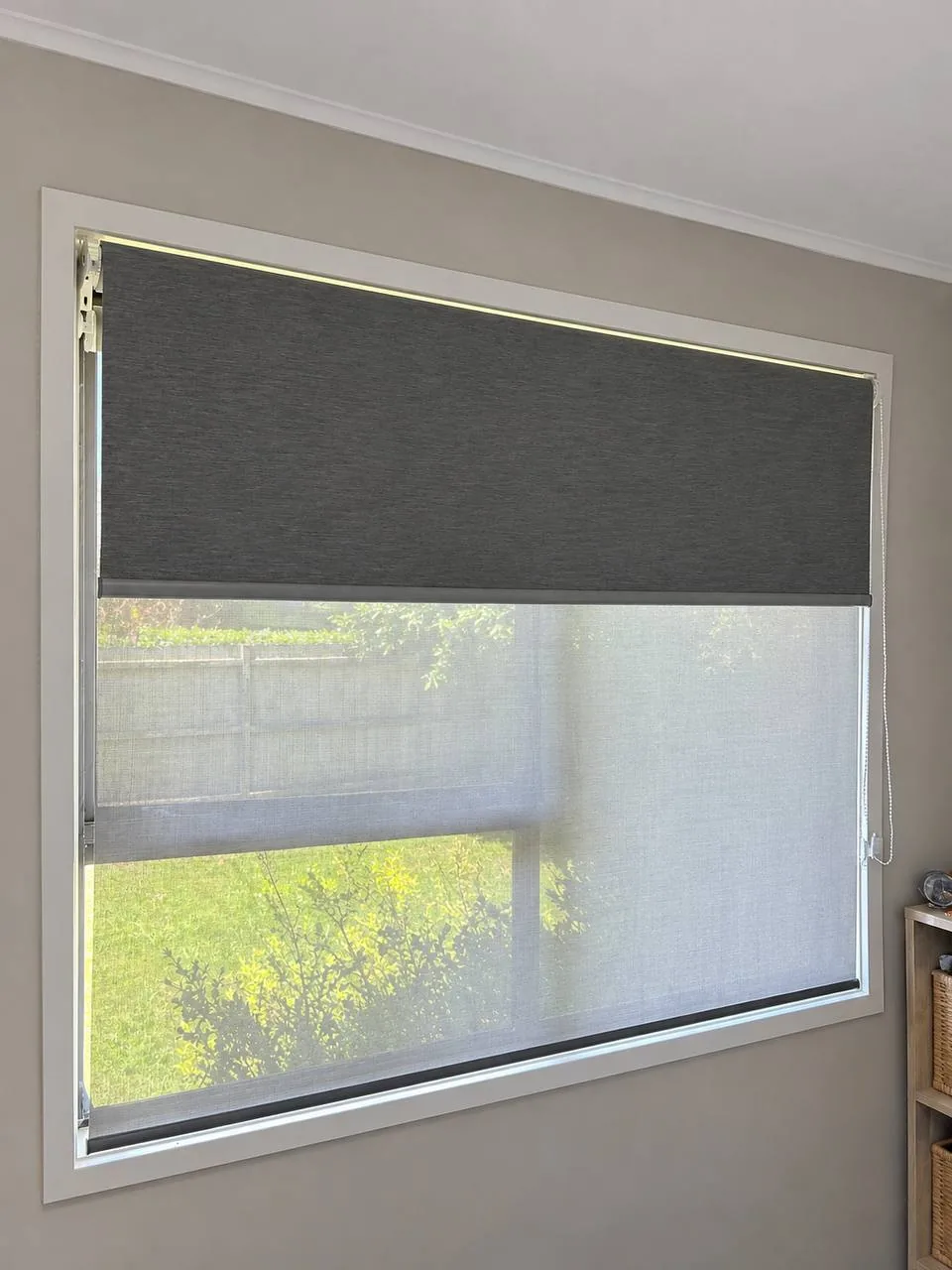
Two rollers, one pair of brackets. The front roller carries blockout fabric; the roller behind it carries a light-filtering or sunscreen fabric. Both are operated separately, by their own chain or motor, so you are not choosing between the two fabrics - you are choosing which one is down.
That is the whole idea, and it is why the brackets matter more than the fabric. A double bracket set is deeper than a single one and has to be fixed into sound framing, because it is carrying twice the weight and twice the pull. On a window with a shallow reveal that is the first thing we check.
The two fabrics, and which one goes in front
Blockout at the front is the usual arrangement. It is the fabric that has to sit closest to the room to do its job, and having it in front means the sunscreen behind is protected from the sun when the blockout is down.
Sunscreen at the front suits a room where the view matters more than the darkness - a living room facing west, or a kitchen where you want to see out while cutting the late glare. You still get the blockout when you need it, just from the back roller.
One rule worth knowing: two blockout fabrics on one window is money poorly spent. The pair works because one fabric darkens and the other filters. Two of the same does the same job twice.
Where they earn their keep
Bedrooms. This is the classic case. A blockout blind alone makes the room dark but leaves you sitting in a dim room all day; a sunscreen alone never gets dark enough for a summer morning. The pair solves both without a curtain over the top.
Living rooms with a big west or north window. Sunscreen down through the afternoon kills the glare on a television and the heat on the floor, and the blockout is there for the two weeks a year the room overheats.
Home offices. A screen you cannot see is a bad afternoon. Sunscreen keeps the room bright and the monitor readable, and the blockout handles a video call at 4pm.
Rentals and investment flats. One fitting that covers both jobs is cheaper than two separate blinds and it is the sort of detail a tenant notices and a property manager does not have to explain.
What decides the job at the measure
Reveal depth. Two rollers need roughly twice the room of one. Where the reveal is shallow we fit the pair over the architrave instead of inside it, with a cassette or fascia closing the top. That is a measurement decision, not a preference - it has to be settled before the order goes in.
Cassette or exposed roll. A cassette hides both rolls and gives the window a clean line; an exposed set is cheaper and shows the fabric roll at the top. On a double it is usually worth the cassette, because two exposed rolls look busier than one.
Chain side, and how many chains. Two blinds can mean two chains on the same side, which is fine on a wide window and fussy on a narrow one. Some bracket sets let one chain drive both rollers in sequence - worth asking about.
Motor or manual. On a tall window, or one behind a bed, motorising the blockout is the difference between using it and leaving it up. The sunscreen stays on a chain in most houses.
Where they are not the right answer
A very shallow reveal with no room for a fascia, a window with a deep architrave you do not want to cover, and a tight budget on a room that only needs one job done. In those cases a single sunscreen plus a curtain, or a single blockout, is the honest recommendation - and we will say so at the measure rather than sell the pair.
What changes the price
A double is two blinds on one bracket set, so it costs more than a single roller on the same window. What moves the number: the fabric (blockout and sunscreen sit in different price bands), the width, whether there is a cassette, and whether either roller is motorised. We quote the single and the double side by side so the difference is visible rather than implied. Current fitted ranges for every blind type are on our Auckland price guide.
Care, and the one fault we get called about
Two rollers gather twice the dust at the head, and a sunscreen holds it more visibly than blockout. A vacuum brush head once a season is enough. The fault we are called about most is a roller that will not retract - usually a spring tension issue rather than a broken blind, and it is covered in why a roller blind will not roll up.
Questions we get asked
Can I add the second roller later? No. The bracket set and the cassette are decided at order, so the double has to be specified as a double from the start.
Does the sunscreen still give privacy at night? Not really - a sunscreen is private in daylight and see-through once the room is lit. That is exactly why the blockout is on the same window.
Will two rollers fit inside my window frame? Sometimes. It depends on the reveal depth and the frame; we check it at the measure and fit over the architrave with a fascia when it does not.
Do both rollers have to be the same colour? No. Most people match them, and a matching pair does read more calmly on the window, but it is your call.
Seeing one before you decide
We measure in your home, make the blinds to those measurements, and the same team installs them. If you want to see how a double sits on a window like yours, the double roller blinds page has recent Auckland installations, and the roller blinds page covers the single version.
Measure and quote, in your home
Free with five coverings or more. One visit to measure and quote, one visit to install.
Get a free quote Call 09 390 1000